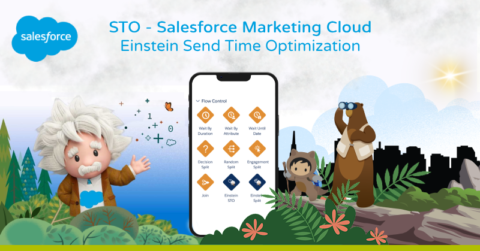
STO – SFMC Einstein Send Time Optimization

STO Salesforce Marketing Cloud Einstein Send Time Optimization

It is undeniable that in the digital world, every interaction counts. The success of a campaign can depend on the ability to reach customers at the right moment. Salesforce Marketing Cloud has incorporated an innovative and revolutionary tool called Einstein Send Time Optimization (STO), which uses artificial intelligence to optimize the timing of emails in our marketing strategies.

This article will teach us in detail what STO consists of, the importance of timing in Salesforce Marketing Cloud, how the tool works, and the advantages of implementing it in our strategy planning.

Definition of STO in SFMC

As defined earlier, the abbreviation STO, Einstein Send Time Optimization, is nothing more, nothing less than a unique and distinctive feature of Salesforce Marketing Cloud.
Einstein Copilot

It is a tool that uses artificial intelligence (AI) to determine the optimal time to send emails to each email address or individual, optimizing and personalizing the send based on the individual’s history, behavior, or preferences.

Why Send Times are Important in SFMC

In a time when we receive an immense amount of emails in our inbox, receiving a message at the right time can be crucial and can significantly impact the open and click-through rates.

This action could improve the effectiveness of our marketing campaigns and strengthen the bonds with our customers.

STO - Einstein Send Time Optimization

It is an advanced tool within the SFMC universe focused on send optimization. STO, unlike traditional methods that set a fixed schedule, uses artificial intelligence algorithms to personalize the send for each contact.

Incorporation of Artificial Intelligence

The essence of STO lies in the integration of artificial intelligence, specifically Einstein, Salesforce’s AI engine. This fusion allows for a deep analysis of historical data and behavioral patterns, generating accurate predictions about the most opportune moment for interaction.

Operation of STO in SFMC

Examining the Interaction Log

Einstein Send Time Optimization carefully analyzes the interaction history of each individual by examining clicks, opening patterns, and other behaviors to understand past activity perfectly and predict the best future moment.

Predicting the Perfect Sending Time

Based on all this and using predictive algorithms, it determines the best time to send the message to each individual. STO goes beyond simple scheduling and dynamically adjusts to the recipient’s habits at each moment.
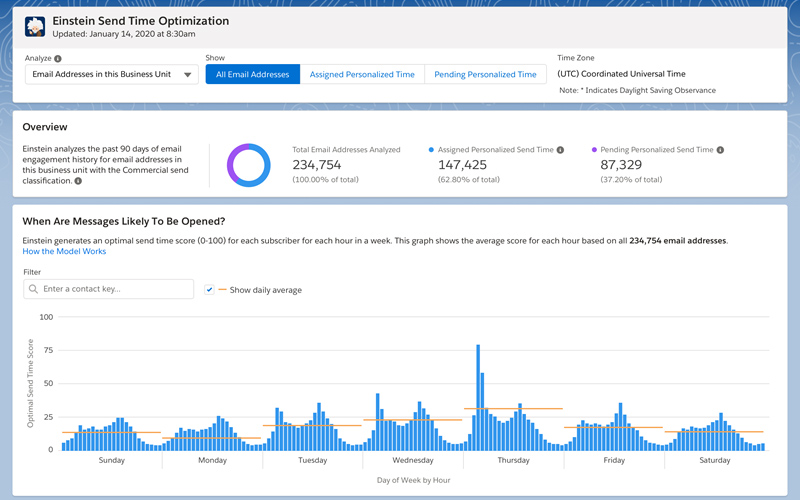
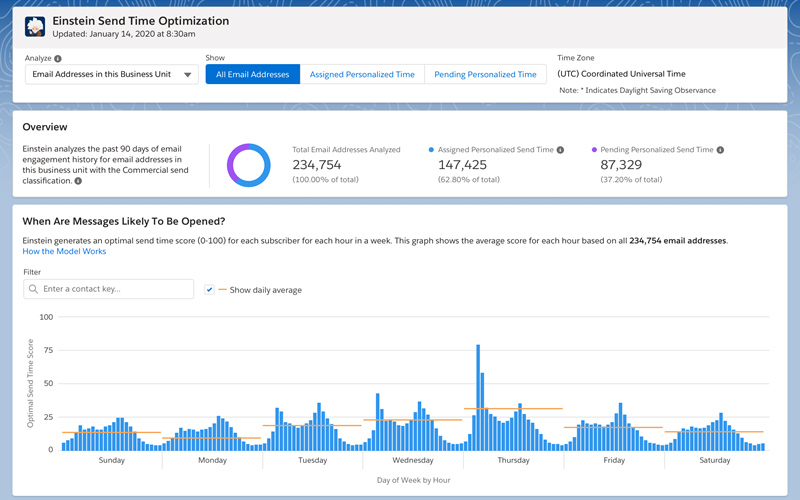
Enstein Send Time Optimization
STO Enstein overview model

Advantages of Implementing Einstein STO in Your SFMC Strategy

Optimization and Maximization in Campaign Effectiveness

By implementing Einstein STO in our journey, our campaigns will experience significant and relevant optimization. Messages will be received at the most opportune moment, enhancing effectiveness and improving campaign results.

Increase in Participation and Open Rate

We typically measure the effectiveness of our campaigns through open and click-through rates, and this is where one of the most significant benefits of using STO can be observed. It is proven that such personalization results in increased attention from recipients.

Real-Time Personalization

As mentioned earlier, it is not just about simple scheduling; STO allows instant adaptation to real-time changes in user behavior, creating a tool that provides more relevant and timely messages.

Points to Consider and Best Practices

Ensuring Accuracy and Relevance of Information

An essential part is ensuring the quality of the data used by STO. The tool’s predictions depend directly on the accuracy and study of historical information.

Continuous Monitoring and Evaluation

Successful implementation involves constant monitoring and continuous evaluation of results. Adjusting strategies as needed ensures effective adaptability to changes in customer behavior.
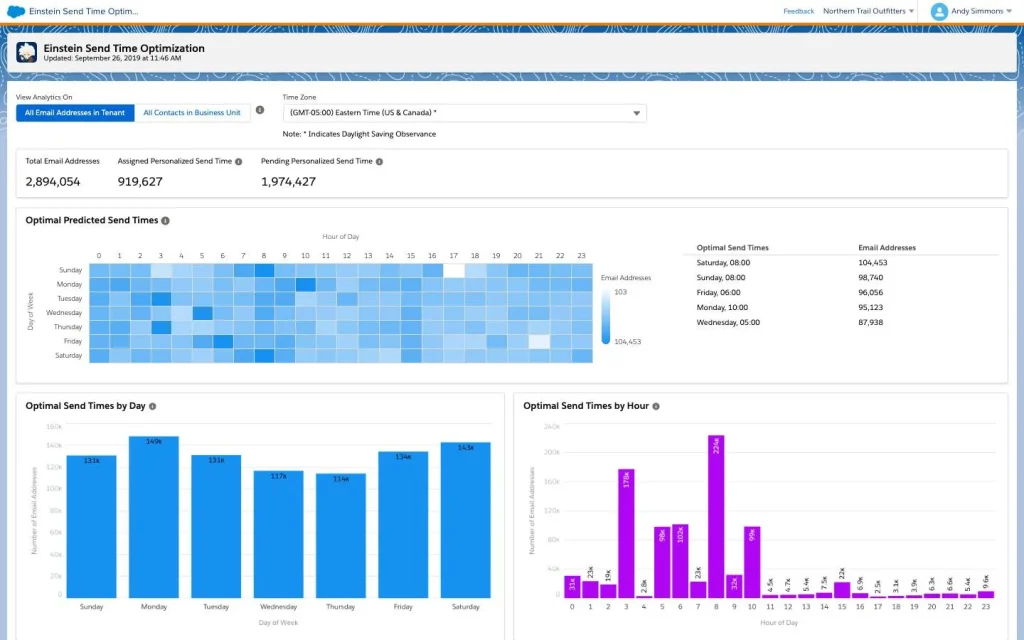
Enstein Send Time Optimization.
STO Enstein Analytics

Integration with Other Marketing Strategies

A good marketing strategy is one that blends different marketing tools. It is a best practice to integrate STO with other marketing instruments to strengthen the overall strategy.

Final Conclusion

Review of Einstein STO Advantages

In conclusion, reviewing the advantages offered by Einstein STO highlights the transformation it can bring to strategies in Salesforce Marketing Cloud. Time optimization is currently a key and differentiating factor for success in our campaigns.

The Future of STO Optimization

As an additional note and looking towards tomorrow, we will continue to explore the future of send time optimization in digital marketing. With the current perspectives for the future and the innovations being hinted at, the effectiveness of marketing strategies will undoubtedly continue to be refined.

STO is not just a current solution; it is a vision of the future of personalized and efficient marketing.
Would you like to know more about field validation on SFMC forms? Visit these links:

Marketing Cloud Einstein

Marketing Cloud Einstein

Einstein, the powerful artificial intelligence tool that Salesforce has incorporated into its Marketing Cloud digital marketing platform, is going to help us answer them.

At what time am I most likely to have my contacts open my emails? 

Can I get to know my subscribers and their interactions with my brand even better?

What will be the optimal sending level for each of my subscribers? 

Can I do anything else to reduce the unsubscribe rate or my emails being reported as spam?

These are questions that any marketing manager has asked many times.

Einstein’s set of functionalities provide us with valuable knowledge of our customers both as a whole, as well as on an individual level, knowledge that we will also be able to apply effectively and quickly to create much more personalized customer experiences across all communication channels.

As we will see, some of the features of Einstein and its interactions with Journey Builder, the great “jewel in the crown” (option B – an already very complete and powerful tool) within Marketing Cloud, end up “fine-tuning” even more if possible the already excellent tool that is Journey Builder.

Let’s briefly explain the main features of Einstein available in Journey Builder:

Send Time Optimization

At what time am I most likely to have my contacts open my email?

Simple and effective. This feature of Einstein becomes a valuable help to answer the question that all of us responsible for digital communications ask ourselves every time we launch a mailing, Einstein STO allows us to add an activity in Journey Builder prior to the email activity that will decide for each contact, within the time interval that we indicate, the best time to send the email.

Einstein Send Time Optimization model:

  • Input: The model makes calculations using up to 90 days of your contacts’ engagement and behavioral data, including when messages are sent and opened.
  • Output: Each hour is assigned a score for each contact. Contacts are more likely to open a message if it’s sent during an hour with a high score.
  • Model: The model analyzes each contact’s best send hours and engagement data. Send hours that have higher open rates are likely to have higher scores. When send-hour history doesn’t provide enough information, recommendations rely on engagement data to generate analysis.

Einstein Engagement Scoring

Can I get to know my subscribers and their interaction with my brand even better?

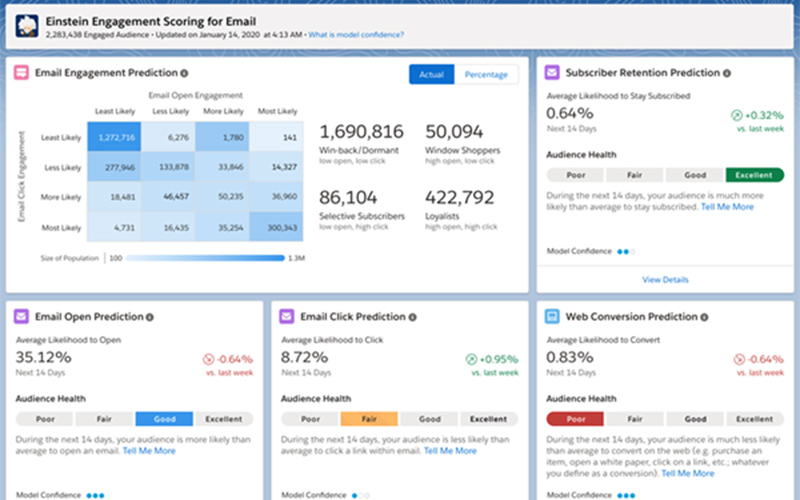
Einstein Engagement Scoring is a predictive segmentation tool for SFMC that predicts subscriber engagement with your email campaigns over the next 14 days.

Another great feature that comes to reinforce Journey Builder allowing us to add a Scoring Split based on the engagement of our subscriber with the email or with our apps.

Einstein categorizes our subscribers into the following groups:

  • Loyalists: High open and high click engagement
  • Window Shoppers: High open and low click engagement
  • Selective Subscribers: Low open and high click engagement
  • Winback/Dormant: Low open and low click engagement

In this way we can create different branches in the journeys using the drag & drop system and therefore further customize the customer experience.

In addition, in the email channel, we can also choose to create different communication flows based on the propensity for certain actions: likelihood to open the email, to click, to convert on the web or even to remain subscribed.

Einstein-engagement-scoring

Einstein Engagement Frequency

What will be the optimal level of sends for each of my subscribers? Can I do anything else to reduce the unsubscribe rate or to keep my emails from being reported as spam?

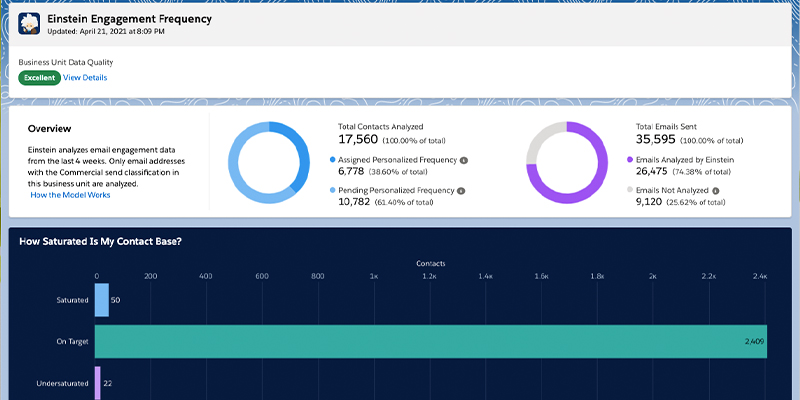
To help us find that difficult balance point, Einstein Engagement Frequency provides an optimal range of how many emails to send over a given time period, comparing send frequency and engagement trends and getting suggestions of the optimal send rate.

This functionality will allow us to identify those subscribers who are already oversaturated and also the opposite case, those subscribers we are “under-engaging”.

The Split Frequency available in Journey Builder, which like the previous ones works through the drag & drop option, allows us to establish different routes for customers based on four categories:

  • Saturated
  • Almost Saturated
  • On Target
  • Undersaturated

Einstein Engagement Frequency model:

  • Input: The model makes calculations using the last 28 days email engagement and behavioral data, including when messages are sent and opened, and unsubscribes.
  • Output: Each contact’s engagement data is analyzed in comparison to the frequency of messages sent to them to generate a personalized engagement frequency score. Based on this score, contacts are classified as having Saturated, On Target, or Undersaturated message frequency. This data is used to inform how often you send messages.
  • Mode: The model analyzes how often each contact is sent to and how send frequency affects engagement. Engagement generally increases when send frequency increases until a contact reaches saturation. Contacts without enough send frequency data to generate a personalized engagement frequency score are treated as part of the On Target segment.

As I mentioned at the beginning, all these functions will help us to improve our subscriber’s individual experience through their direct application in Journey Builder, but they also enhance our global knowledge of our customers, since each of them has its own Dashboard.

einstein-engagement-frequency