Leer este artículo en español →
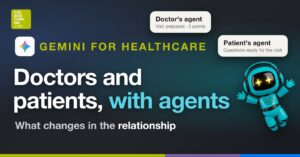
Gemini for Healthcare is Google's AI agent for hospitals, health systems and insurers: one layer that sits on top of the systems they already use, reads them with each person's existing permissions and puts each patient's information together, with a source for every answer and a person making every decision. For a long time, care started when the patient walked into the doctor's office. This launch is one of the clearest signs that this is changing. Here is what Gemini for Healthcare is, how it works, and where it takes the relationship between doctors and patients.
Joaquín País, CEO of ShowerThinking, also explains it on video:
The problem: patient information lives in many places
Everything about a patient sits in different systems: the medical record, lab results, letters from other specialists, clinical guidelines and the rules about what is covered. Before every visit, someone has to pull it together by hand.
According to Google, clinicians lose nearly 28 hours a week to documentation and admin work. That is time that doesn't go to patients, and it is exactly the kind of work an AI agent can take on.
What is Gemini for Healthcare?
It is a version of Google's Gemini agent (the one in Gemini Enterprise) built for healthcare. It doesn't replace the medical record or move the data somewhere else. It sits on top of the existing systems, reads them with the same permissions each user already has, and does the work of putting the pieces together.
Google builds it from four pieces:
It is the same idea we cover in what an enterprise AI harness is: the value isn't only in the model, but in everything around it that lets it work with an organization's data and rules.
How does Gemini for Healthcare work in practice?
The clearest example is preparing a visit:
- Before the visit, the doctor asks the agent to prepare the patient.
- The agent reads the medical record and the documents that came from another clinic, and checks the guidelines and the coverage rules.
- It comes back with a short summary of what needs attention at that visit: a screening that's due, a missing vaccine, a mismatch in the medication list.
- If the doctor agrees, it turns that into a checklist for the team and a draft note for the patient.
On the insurer side, the same agent reviews requests against the coverage policy or estimates a patient's benefits.
What safeguards does it have?
This is what makes it something a hospital can actually use:
- Every answer comes with its source, so the doctor can check where it came from.
- It reads the medical record but doesn't write in it.
- Everything it produces is a draft, and a person always makes the decision.
- Each agent has its own identity and inherits the user's permissions, with end-to-end auditing.
- The data doesn't train Google's models: according to Google, clinical data, prompts and outputs stay inside the organization's environment. Google describes it as built to support HIPAA compliance.
How will AI agents change the doctor-patient relationship?
Gemini for Healthcare is only the first step. The way we see it, there are three horizons.
Horizon 1: the doctor's agent
This is the one we've just described. The agent prepares, gathers and takes on the paperwork. The doctor spends less time looking for information and more time interpreting it and deciding.
Horizon 2: the patient's agent
It has already started. OpenAI (ChatGPT Health), Microsoft (Copilot Health) and Amazon (Health AI) have launched health assistants for patients that can connect to their medical records, and some already explain lab results or help with the next appointment. The patient arrives at the visit prepared, with better questions, and gets help following the treatment between one visit and the next.
Horizon 3: both agents together
This comes when both agents work together, always with the patient's permission. The patient's agent shares what happens between visits, the doctor's agent puts it in context with the history and the guidelines, and care stops depending on an appointment every few months. Problems can be spotted earlier, prevention becomes part of everyday life, and treatment is easier to follow.
The agents prepare, alert and explain. The diagnosis and the decision stay with the doctor.
What it takes to get there
- Patients control what they share.
- Every piece of information has a source anyone can check.
- It is clear who is responsible for each decision.
- Systems can talk to each other.
- No gap opens between people who have an agent and people who don't.
And one warning: many patient health assistants aren't covered by the same health privacy rules as a hospital. According to the IAPP, none of the five main ones is a HIPAA-covered entity, so what users connect falls outside that protection.
From occasional to continuous care
The relationship between doctors and patients is moving from occasional to continuous. The visit becomes the moment where two well-prepared people meet, and a lot of the care happens in between.
The same goes for any process where someone has to gather information from many places before deciding: the agent takes that part, and the person keeps the judgment. If you want to see how an agent can go one step further and flag things before you ask, we explain it in what Claude Duet is.
Frequently asked questions
What is Gemini for Healthcare?
An extension of Google's Gemini agent built for hospitals, health systems and insurers. It connects to the medical record and to trusted sources like clinical guidelines and coverage rules, and handles work such as summarizing a patient's history, preparing a visit or reviewing coverage.
Does Gemini for Healthcare make clinical decisions?
No. Every answer comes with its source, it reads the medical record but doesn't write in it, and everything it produces is a draft that a person reviews and decides on.
Which AI models does Gemini for Healthcare use?
The platform lets each organization choose models from Google, Anthropic or OpenAI, according to Google Cloud's press release.
What happens to patient data?
According to Google, clinical data, prompts and outputs stay within the organization's governed environment and are not used to train its models.
Is Gemini for Healthcare available?
At launch it is in preview in the United States for Gemini Enterprise Standard and Plus customers.
How will AI change the doctor-patient relationship?
Our view: in three steps. First the agent arrives on the doctor's side, then patients use their own health assistants, and finally both agents work together with the patient's permission. Care stops depending only on the visit, and the diagnosis and the decision stay with the doctor.
Sources
How ShowerThinking can help
ShowerThinking is a Claude partner and an OpenAI partner. We help bring AI agents into real processes, starting with what data they need, who approves what, and where a person always has to stay in the loop. If you want to see which part of your work an agent could take on, get in touch and we'll look at it in a 30-minute session.