Leer este artículo en español →
The Salesforce Enterprise AI Harness is the layer around an AI model that connects it to a company's data, permissions and rules, so AI agents can work on real business processes and you can trust what they do. Salesforce is building it out of Data 360, its data layer, and calls it the future of its platform. This article covers the problem it solves, where the word "harness" comes from, the six capabilities it is made of, how it works day to day and what it means if you are about to put agents on your processes.
Joaquín País, CEO of ShowerThinking, also explains it on video:
What is the Salesforce Enterprise AI Harness?
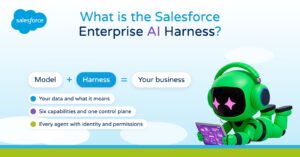
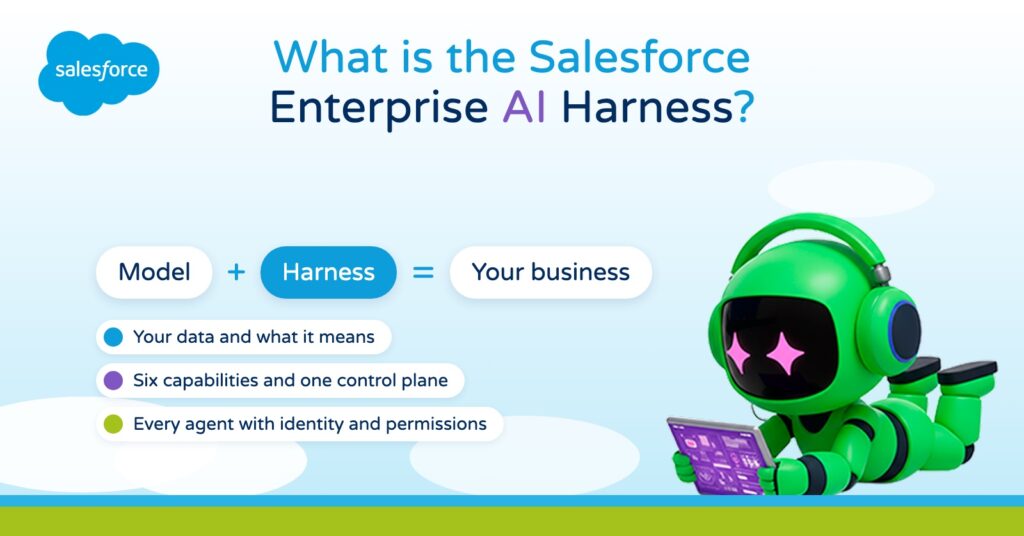
Salesforce sums it up in one line: the model brings the intelligence, the harness brings your business.
In practice, the harness is everything that surrounds the model inside a company:
- Your data and what each field means.
- Your workflows and approved processes.
- Your permissions and policies.
- The controls to see what every agent does and what it costs.
It is not a new cloud, and it is not another agent. It is the layer underneath. Models and agents will keep changing every few months; the harness is the part that stays.
The problem: a model does not know your business
Large language models are very good at reasoning and planning. But a model knows nothing about your company. It knows what an order is. It does not know that this customer has called three times this week about it, or that the stock is stuck in a warehouse in Italy.
There is a second problem. A model is probabilistic: it gives you the most likely answer, which is not always the true one. A business needs the true one, every time, within each person's permissions and the company's policies. Intelligence alone cannot run a business. It needs something around it.
Where the word "harness" comes from
The word is not Salesforce's. In AI, a harness is everything around the model that is not the model: the loop that calls it, the tools it can use, the memory it keeps and the permissions it works under. Anthropic used that definition on its engineering blog in November 2025.
If you use AI every day, you already work with one:
- The ChatGPT and Claude desktop apps are harnesses: they give the model your files, a browser and connectors to your tools.
- Coding agents like Claude Code and Codex are harnesses for the terminal.
- Open source personal agents like OpenClaw (which started as Clawdbot in November 2025) and Hermes Agent (released by Nous Research in February 2026) run on your own machine and talk to you through WhatsApp, Telegram or Slack.
All of them wrap a model with tools and memory for one person. What Salesforce adds is the enterprise part: the whole company's data, permissions and governance, with someone accountable for every agent.
The six capabilities of the Enterprise AI Harness
Salesforce splits the harness into six capabilities, held together by what it calls the AI control plane:
On top sits the AI control plane: one registry that discovers every agent in the company, including the ones built on Microsoft, Google or Amazon, with cost and performance in one place.
How it works day to day
First, the harness scans your systems: databases, APIs, models and the agents already running, wherever they run. Then it builds the context:
- Structured data gets a glossary, so the agent learns that your fiscal Q3 ends in October, not September.
- Documents in SharePoint or Google Docs get indexed and linked.
- Context packs: you describe in plain English what a group of agents needs, instead of handing them fifty thousand files.
Salesforce gives an example. A sales rep asks which customers to focus on to close her quarter. With raw data access, the answer was wrong and cost 43,000 tokens. Through the harness it was right, came with the reason why, and cost 7,000.
Then comes trust. Each agent gets its own identity and permission sets, like a user. If it is not allowed to grant a pricing exception, it stops and a person with that authority approves it. Data is tagged automatically, and you can mask fields so no model ever sees them. Evals check that agents keep behaving the same after every change. And every model call goes through one gateway, with a budget per model.
What it is made of, and what it works with
The harness is assembled from products that already exist, and that you may already own:
- Informatica for data quality.
- Data 360 for context. If you know it by its old name, we cover it in What is Data Cloud?
- Agent Builder for building agents.
- Agent Fabric as the control plane.
- Guardian for agent security.
- Tableau for business semantics.
It is designed to be open. Every capability is available through headless APIs, so you can use the context from an agent built on another platform, and keep another vendor for security or governance if you already have one. You do not have to buy everything from Salesforce. It is the same idea behind Salesforce AIforce: the data and the rules stay in Salesforce, and the AI works wherever people work.
What it means for your automation project
If you are about to put agents on your processes, the bottleneck is no longer the model. It is whether your data means the same thing to the agent as it does to your finance team, and whether the agent has its own identity and its own permissions.
If you are starting, start there:
- One process. A specific one, not the whole company.
- Its definitions. What each piece of data that process depends on actually means.
- One agent, registered like a user. With its own identity and permissions.
The second step is the one most companies underestimate. Models will change every few months. The context and the rules are yours, and they are the part nobody can sell you.
Salesforce Enterprise AI Harness FAQ
What is the Salesforce Enterprise AI Harness?
Everything that surrounds an AI model so it can work inside a company: the data and what each field means, the workflows and approved processes, the permissions and policies, and the controls to see what every agent does and what it costs. Salesforce builds it out of Data 360.
What is a harness in AI?
Everything around the model that is not the model: the loop that calls it, its tools, its memory and its permissions. The ChatGPT and Claude desktop apps, Claude Code and Codex are harnesses for one person. Salesforce's is for a whole company.
What are the six capabilities of the Enterprise AI Harness?
Trusted models, trusted context, trusted agency, trusted actions, trusted governance and trusted security. The AI control plane, a single registry of every agent in the company, holds them together.
Which Salesforce products is it built from?
Informatica, Data 360, Agent Builder, Agent Fabric, Guardian and Tableau.
Does it work with AI agents that do not run on Salesforce?
Yes. Every capability is exposed through headless APIs, the registry discovers agents built on other platforms such as Microsoft, Google or Amazon, and you can keep another vendor for security or governance.
When will it be available?
The products it is assembled from are available already. Salesforce has announced the full harness for later on; the planned date is in its press release, linked in the sources below.
Sources
- Salesforce, "Salesforce Introduces the Trusted Enterprise AI Harness", press release, 11 September 2026; planned availability early fiscal year 2028
- Salesforce, "The Enterprise AI Harness for the Agentic Enterprise", Dreamforce 2026 session
- Anthropic Engineering, "Effective harnesses for long-running agents", November 2025
How ShowerThinking can help
ShowerThinking is a Salesforce and Claude partner, and putting AI agents to work on each company's own data and permissions is a big part of what we do. If you want to start with one process, get in touch and we will look at it together in a 30-minute session.